
A Hanford Resident Lookup by Record
Match the question to the record keeper. That is how a Hanford resident lookup works. The assessor fixes a parcel to a situs address, yet an owner is not always the person living there. A deed records a transfer of title, while a court entry adds a name, a case type, and how it ended. Vital records pin down a life event. Business and license files show public ties.
| Record | What It Confirms | Where | Access |
|---|---|---|---|
| Parcel or tax roll | Parcel, situs address, assessment, map | Kings Assessor and GIS | Free address or APN; no owner-name mode |
| Recorded deed | Transfer, parties, date, description | Kings Clerk-Recorder | Counter, written request, or paid access |
| Court record | Name variant, type, activity, disposition | Kings Portal or courthouse terminal | Account, 45-case limit, or terminal |
| Vital record | Birth, death, marriage, divorce, relationship | Kings County or CDPH | Local or state mail and copy rules |
| Voter record | Own status, address, party, approved data | My Voter Status or Kings Elections | Self-check or controlled access |
| Business or FBN | Entity, trade name, agent, filing trail | California SOS and Kings Clerk-Recorder | Free search; some copies cost |
| Professional license | Status, number, dates, discipline | California DCA or board | Free public search |
| ClaimIt | Old city, holder, address, heir clue | California State Controller | Free lead; proof still required |
Choose the path that fits. Names go through court search; addresses and parcel numbers go through the assessor. Ask the recorder when you need the parties to a transfer. Family questions belong with vital custodians. Affiliations come from business and license records. One caution applies to property hunters: the free Kings property route is not an owner-name directory.
Two Anchors for a Hanford Resident Lookup
A common name proves nothing by itself. Build each Hanford resident lookup on two independent anchors. Pair a full or variant name with a parcel, a spouse, a business, a filing date, a profession, or another party. Run maiden and married names, initials, and spelling variants as separate searches. Two records that agree are far stronger than one.
Good pairings help. Put a court name beside an address or business. Match a deed party to an APN. Tie a marriage to both spouses, or a license to an occupation and business address. Dates set the outer limits of what a record can mean. A deed shows ownership when it was recorded, not who lives there now, and a pleading is never a finding. When the question widens to everyone at one address, the Hanford by-street records route takes over.
Note: A dated record can support an identity match, but it cannot turn an old address or title entry into proof of present residence.
Hanford Court Search: Portal or Terminal
The Superior Court of California, County of Kings, sits at 1640 Kings County Drive and handles Hanford's civil, criminal, family, juvenile, probate, traffic, and small claims matters. Two access routes exist. The Kings County Portal needs Register/Login and the account email, and a public account caps at 45 cases a day. Name search is confirmed. A case number opens the full register of actions.
Know the limits. Recent filings may lag behind the paper file. Electronic data is not official unless the court electronically certifies it. Inside the courthouse, terminals search nonconfidential records by name or case number. Local Rule 117(C) bars photographing viewed documents. Sealed matters require entitlement or a court order.
| Register / Login | Required gate; the account email is the login. |
|---|---|
| Name | Post-login criterion confirmed by the court; exact choices were gated. |
| Case Number | Confirmed criterion for a case or citation. |
| Case, category, or date filters | Exact labels, coverage date, sorting, and export were not confirmed. |
The Kings Superior Court records office lays out the counter and terminal route, which is worth reading before any copy request.
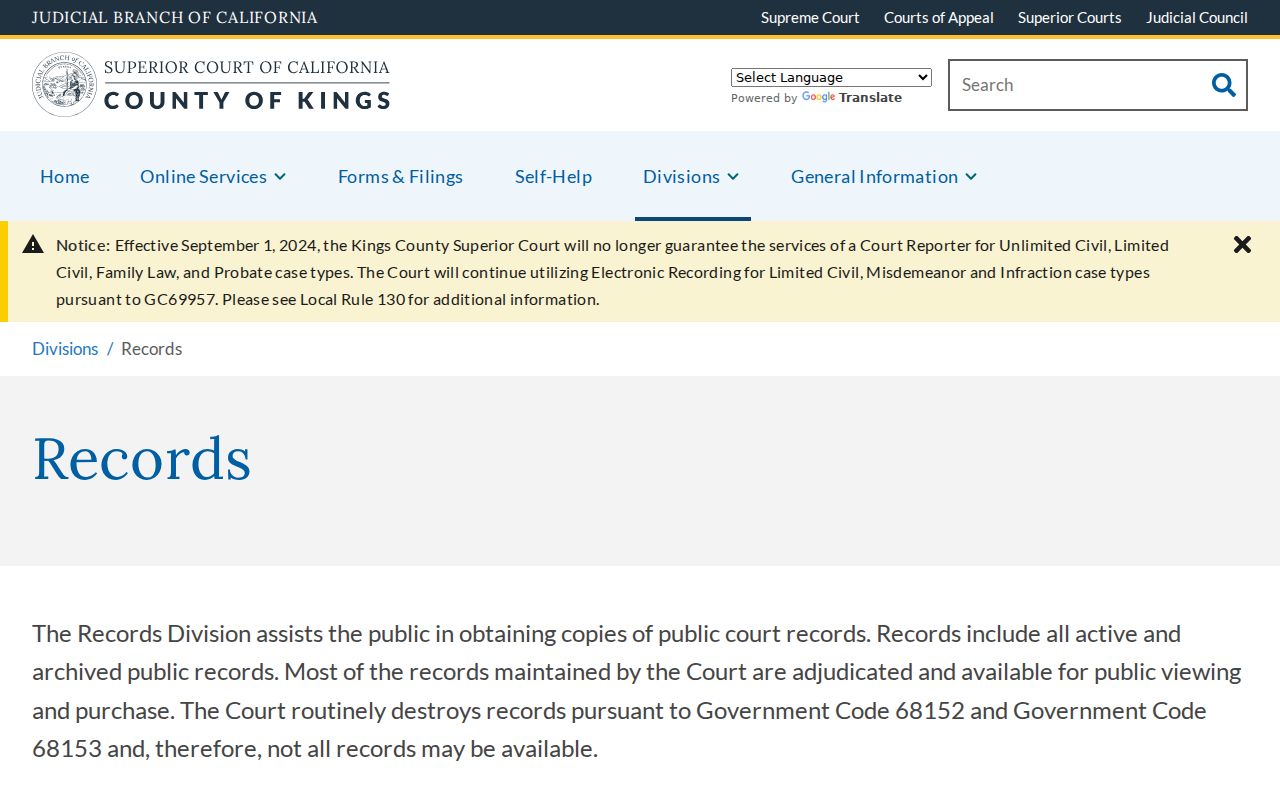
The image marks the boundary that counts: a web result, a courthouse view, and an official file are related steps but not the same record.
Hanford Dockets and Certified Copies
A promising court hit deserves a slow read. Clicking a case number opens the register of actions. That is the running log of filings and hearings. Weigh party name, case type, dates, and disposition against your second anchor. A name that matches is not proof that the person matches.
What a court result can show. A Kings result may list a party name or AKA. It may also list a case or citation number, the case type, the register of actions, and a disposition when one exists. The name catches the variant you searched. The number separates one matter from another. The type names the court category. The register gives dated activity, and the disposition supplies the status or outcome the court displays.
- Party name or AKA: tests the name and its variants.
- Case or citation number: separates matters and opens the register.
- Case type: identifies the court category.
- Register of actions: shows dated public activity.
- Disposition: lists status or outcome when available.
- Docket
- A court's running case log, called the register of actions in Kings.
- Index
- A finding aid, not the document itself.
- Image
- A scan of a filed page; an index hit can lack one.
- Certified copy
- A clerk-attested copy matching the court record.
No case number? Clerk research runs $15 per name for each ten minutes. The form asks for the requester and any AKA, plus contact details. It also wants the case type, the searched name and date of birth, the other party, filing years, documents wanted, and certification choice. File it in person or by mail, never electronically. Mail needs an advance check, money order, or cashier's check payable to Kings County Superior Court. A stamped return envelope is required too. Cash is not accepted.
Listed court charges: copies run $0.50 per page under Government Code section 70627(a); comparing a copy with the original costs $1 per page under section 70627(b); certification is $40 under section 70626(a)(4); exemplification is $50 under section 70628; and a certified dissolution record costs an ordinary applicant $15 under section 70674.
Print the Kings court record-search and copy request form to keep a paper trail. Federal matters are different. The PACER Case Locator searches federal names and case numbers. It covers the Eastern District of California. Documents bill at $0.10 per page, capped at 30 pages. Quarterly charges of $30 or less are waived. PACER still cannot replace Kings Superior Court.
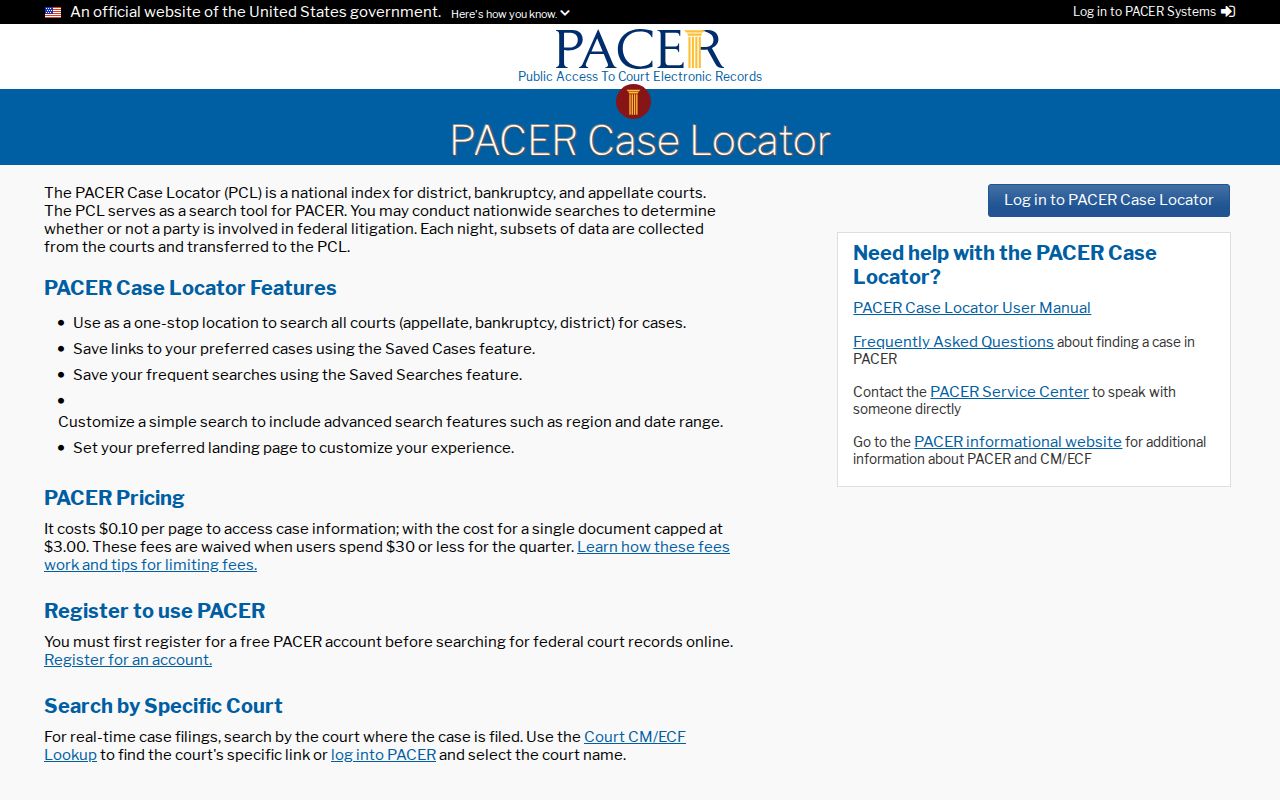
That line matters because a federal search answers only federal questions, and a quiet county record should never pass for a nationwide result.
Note: A PACER hit answers a federal-court question; a Kings result answers a local trial-court question, even when the names match.
Hanford Vital Records, Local and State
A certificate ties one Hanford resident to one event. It is not a name directory. Kings County keeps the births, deaths, and marriage licenses that happened locally, so most Hanford events route through the county first. The Clerk-Recorder accepts mailed applications at 1400 W. Lacey Boulevard, Hanford, California 93230. Count on three to five business days of processing. Priority Mail return costs $11 extra. Anyone asking for an authorized copy by mail must add a notarized sworn statement.
The state path works differently. CDPH holds births and deaths from July 1905 onward, but only by mail. It has no public counter, and it never sends certificate images by email or fax. Expect four to six weeks on average. For a Hanford event, the county route is usually quicker, and its copy rules still ask the applicant to state a relationship and a purpose.
| Record | Local or state route | Copy rule and fee |
|---|---|---|
| Birth | Kings for a Kings event; CDPH from July 1905 | Authorized or informational; $34 county, $31 CDPH |
| Death | Kings Recorder or CDPH | Authorized or informational; $26 county route |
| Public marriage | Kings if licensed there; CDPH statewide | Authorized or informational; $19 county route |
| Confidential marriage | Issuing county clerk | Parties or court order; no open informational route |
| Divorce | Kings Court decree; CDPH covered certificate period | CDPH $18; court certified record $15 ordinary applicant |
| Before July 1905 | County registers, churches, cemeteries, newspapers, libraries, archives | Repository-specific |
California treats vital records with care. Health and Safety Code sections 103525-103526 split copies into authorized and informational types. The clock rules people expect do not apply. Births are not opened after 100 years. Deaths are not opened after 50. An informational birth, death, or nonconfidential marriage copy is generally available to anyone. It is stamped as not valid to establish identity. Authorized copies go to the registrant, close family, specified representatives, people with a court order, and qualifying officials. Confidential marriages fall under Family Code section 509, and adoption records stay sealed.
Every application asks for the event city, date, names, your relationship, purpose, copy type, payment, and a declaration against fraudulent use. The Kings County vital-record application lays out the mail and counter route. It includes the notarized sworn statement an authorized-copy request requires. Fees can still be due when no record turns up. A certificate never substitutes for probate, a deed, or a court file.
Note: County and CDPH channels can both be valid for a Hanford event, yet their copy rules, speed, and proof of identity are not interchangeable.
Hanford Voter Status Has a Narrow Door
California's My Voter Status tool checks one person: you. It is self-authentication, not a public Hanford name directory. The official voter status lookup wants a name, date of birth, and a California driver license or ID number with the last four of the SSN. Voters without either can use no-ID and no-SSN declarations instead. Once in, an authenticated voter sees registration status and location, party, language, vote-by-mail or provisional standing, polling place, the next election, county contact details, and guide preference. Wait a full day after registering. Close the browser when finished.
Field notes: first and last name are both required to authenticate; the birth date runs through month, day, and year selectors; the California DL or ID route pairs with the last four digits of the SSN; the form never accepts a full SSN, only the last four; and the no-ID or no-SSN boxes offer conditional alternatives before a call to Elections.
That self-check cannot browse a neighbor. Another Hanford resident's entry sits in the controlled voter file, and Kings Elections guards it. The office sits at 1400 W. Lacey Boulevard, Building 7, open Monday through Thursday, 8 a.m. to 5 p.m., and Friday, 8 a.m. to noon. Phone lines run at 559-852-4401 or 800-289-9981 extension 4401. Elections Code sections 2194 and 2188 require a stated purpose, ID, payment, and a signed use agreement. The Kings County voter-file application must travel in person, by mail, or by courier. Email and fax copies get rejected.
A released file can hold name, address, city and ZIP, status, registration date, party, precinct or district, and participation history. Confidential identifiers and protected voters stay out. The statewide rate is $15 per thousand names, capped at $100. County fees and history windows vary. Government Code section 7924.000 shields address data. Section 18109 makes knowing unauthorized use a misdemeanor. CPRA cannot override the Elections Code limits.
Hanford Business, License, and ClaimIt Clues
A Hanford resident sometimes surfaces faster through a public affiliation than through a residence record. Start with the legal entity, the Kings fictitious business name filing, and the relevant licensing board. Then compare names, dates, status, and business addresses. The California Secretary of State bizfile search returns entity name or number, status, type, dates, addresses, agent, and filings. The California DCA license search adds board, license number, status, dates, and published discipline.
Route notes: the SOS entity file yields a name or number, type, status, dates, agent, and filings for a business affiliation; a Kings FBN links a trade name to its registrant; DCA or a board checks a license number, status, dates, and discipline; and ClaimIt supplies a name, city or ZIP, former holder, or claim path as an old-address or heir lead that still needs proof.
Heir work rewards patience. Combine the probate index or file, the deed or title trail, and a death record with the California ClaimIt search. Searching and claiming cost nothing. The display caps at 500 matches. Data downloads refresh on Thursdays. A deceased-owner claim rests on a Probate Code section 13101 declaration and a Table of Heirship. Proof still decides the claim. Investigator fees are generally capped at ten percent.
Birth-parent searches run on separate rails: sealed-adoption, court, CDPH, and authorized registry processes, including CDPH 9126 where it applies. For a former classmate, verified yearbooks or alumni lists beat guesswork, with official records behind them. Older Hanford clues pair well with the Hanford city directory collections. A directory entry alone still needs a second anchor.
An agent for service, a mailing address, a licensed premise, or a business address can support an affiliation. None of them proves where a person lives.
Hanford CPRA Requests When Portals End
A blank results page is not the end. The City of Hanford public-records route lets you reach the City Clerk by email, fax, mail, or in person. The California Public Records Act, Government Code section 7920.000 and following, backs you up. Under section 7922.535, the agency usually decides within 10 days whether responsive records exist. A 14-day extension is possible.
Write the request with precision. Name the dataset, the custodian, a date range, the record type, and the format you want. Ask for a defined file or index rather than "all information" on a person. Court copies follow court rules. Vital certificates follow county or CDPH rules. Voter limits still sit with the Elections Code.
Good fallbacks exist. Try the proper counter, a written request, county library resources, or the State Library and Archives for older material. Send corrections to the office that holds the record: Elections, CDPH, the Secretary of State, or the court.
Verifying One Hanford Resident Step by Step
Verifying one Hanford resident takes a chain of steps, not one search box. Start a Hanford resident lookup with the basics. Write down the name forms and the clue date first. Keep ownership, occupancy, events, and affiliations in separate columns. Then let each source check the last one. That way the residents directory trail stays honest at every link.
- Set the first anchor. Record the full or variant name and an APN, address, spouse, business, filing date, or profession.
- Choose the right record. Use the assessor for address or APN, the recorder counter for transfers, or business and license searches for affiliations.
- Run the court branch. Search the Kings portal within 45 cases daily. If needed, use a terminal or mail the request with advance payment.
- Add an independent check. Use a vital event, second party, dated filing, license, or permitted voter result. For an heir, add probate, death, title, and ClaimIt proof.
- Certify only when needed. Ask the custodian for the certified copy or official file, and save the source, date, and limits.
The path runs from name variant to anchor, anchor to custodian, dated result to second source, then a certified copy if you need one. Stop if records conflict. A deed may identify an owner, yet voter status answers only the voter's own standing. Aim for one careful match in the resident lookup that anyone can check again.
Legal Limits on a Hanford Resident Lookup
Some records exist to stop a public name search. Kings court rules limit remote display for family, juvenile, guardianship, mental-health, criminal, harassment, elder-abuse, and other protected matters. Sealed files require entitlement or a court order. Confidential marriages stay limited to the parties or a court order, and adoption records remain sealed. Safe at Home, under Government Code section 6215 and following, offers a substitute address, mail forwarding, an authorization card, and confidential voter registration. It does not bind every private business.
California CCPA and CPRA rights cover access, deletion, correction, opt-out, and limits on sensitive-data use. DROP launched January 1, 2026. Registered brokers began processing requests August 1, 2026. Public, first-party, and exempt records may remain anyway. Deletion cannot rewrite a court docket, vital certificate, deed, or voter file. A protected address in the residents directory is not a puzzle to defeat.
Lawful personal use. Use a Hanford resident lookup for family history, reconnecting, estate work, or a public filing. Penal Code section 646.9 and Code of Civil Procedure section 527.6 address stalking and civil harassment; Elections Code section 18109 makes knowing unauthorized voter-data use a misdemeanor. Never use a record to stalk, harass, intimidate, impersonate, or harm anyone.